
Georgia regulations
Georgia termite inspection and contract requirements
Georgia has detailed rules for termite work: who may perform it, what contracts must say, and how real-estate inspections are documented.
01 Who can do termite work
Termite (WDO) work for hire must be performed by a company licensed in the wood-destroying organisms category, with a Designated Certified Operator for that category.
02 What contracts must address
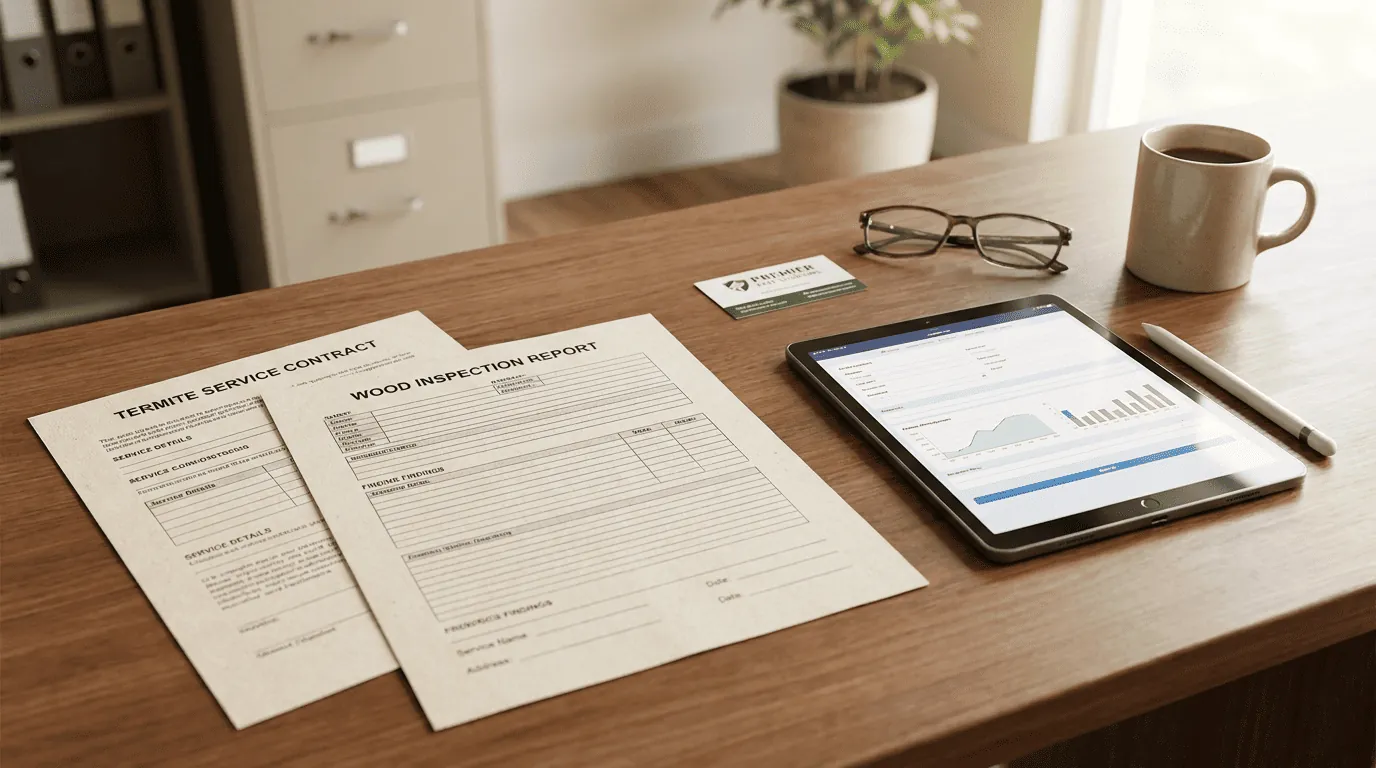
Under Commission rules (Ga. Comp. R. & Regs. 620-6-.02), WDO contracts must indicate whether re-inspections of the structure will be made and their approximate interval, along with other required terms. The Commission’s WDO contract fact sheet (Notice 14-04) summarizes these requirements.
03 Warranty-only contracts
According to the rules, subterranean termite "warranty only" contracts may not be issued in place of a pre-construction treatment, may not be issued on structures with active infestations, are limited to one- and two-family dwellings and townhomes, and require initial and annual inspections.
04 Monitoring-only and baiting
Commission Notice 24-04 says monitoring-only termite contracts must specify a minimum termite control treatment that will be performed if termite activity occurs. Notice 24-01 addresses termite baiting.
05 Real-estate transactions
Real-property transfers use the Official Georgia Wood Infestation Inspection Report.
Questions to ask before signing a termite contract
- Is the company licensed in the WDO category?
- What treatment method and product will be used, and where?
- Will re-inspections be made, and how often?
- Does the contract cover retreatment, repair of new damage, or both?
- What happens if I add on, pave or re-landscape?
- Is the contract transferable if I sell?
Sources
- Ga. Comp. R. & Regs. 620-6-.02 — Contracts
- SPCC Notice 14-04 — WDO Contract Fact Sheet
- SPCC Notice 24-04 — Termite Monitoring Only
- SPCC Notice 24-01 — Termite Baiting
- Georgia Dept. of Agriculture — Structural Pest Control Company License
Sources reviewed November 2026. Regulations change; confirm with the issuing agency.